
| moonbeam | |
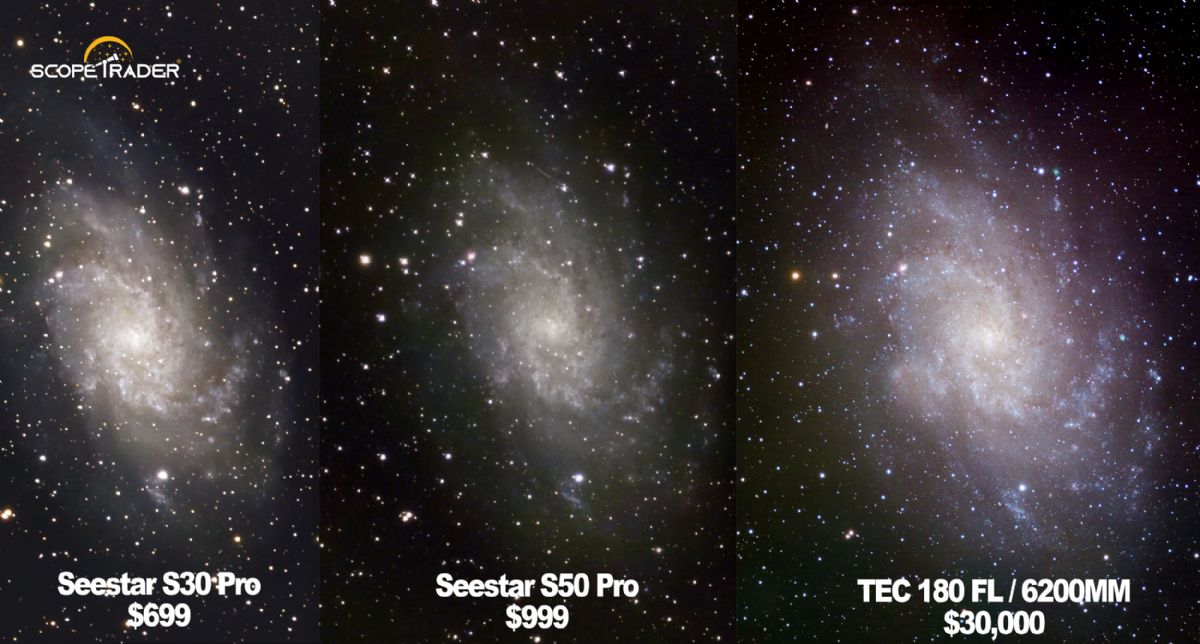
 Joined 6/24/2024 Loc: Mo, USA | Posted 8/27/2026 2:23:18 PM CST I thought this would be a fun comparison because all three of these telescopes were pointed at exactly the same object: M33, the Triangulum Galaxy. All of the photographs in this comparison were taken by me, Richard Harris, from Missouri. Same astrophotographer, same general skies, same target, but three dramatically different approaches to capturing it. At one end is the little Seestar S30 Pro. Then the new Seestar S50 Pro. And finally, somewhat unfairly, my TEC 180FL with an ASI6200MM Pro shooting separate L, R, G and B data. Obviously nobody is cross shopping a Seestar and a TEC 180FL imaging system. That isn’t really the point. What I find interesting is seeing what happens as we move from 30mm to 50mm and finally 180mm of very high quality aperture. Seestar S50 Pro compared to a $30,000 telescope rigHere are the numbers. Seestar S30 Pro 30mm aperture The S30 Pro has an extremely wide field on M33. It captures the entire galaxy with plenty of surrounding sky, and frankly, what comes out of such a small automated telescope is pretty remarkable. But there is only so much information a 30mm aperture can physically collect and resolve. You can sharpen, stack and process the data, but software can’t completely manufacture spatial information that never passed through the aperture in the first place. Seestar S50 Pro 50mm aperture This is where the comparison gets interesting. Going from 30mm to 50mm doesn’t sound enormous, but aperture is an area calculation. The 50mm objective gathers roughly 2.8 times as much light as a 30mm objective. It also has substantially more resolving power, and the longer 260mm focal length puts considerably more of M33 across the sensor. Small structures within the galaxy therefore begin separating much more clearly. That is one reason I think the S50 Pro hits a particularly nice spot for galaxies compared with the S30 Pro. And then there is the TEC 180FL... 180mm aperture This is a completely different class of imaging system. The 180mm aperture has about 13 times the light collecting area of the S50 Pro and 36 times that of the S30 Pro. More importantly for this particular comparison, its theoretical resolving power is roughly six times finer than the 30mm and more than three times finer than the 50mm. Then we put a 61 megapixel cooled monochrome astronomy camera behind it. Instead of every pixel sitting behind a color filter array, the 6200MM records monochrome data through dedicated filters. I can devote substantial integration time to luminance for fine structural information and then collect R, G and B separately for color. The ASI6200MM also gives me a huge 9576 × 6388 pixel image, 16 bit data, regulated cooling and extremely low read noise. That combination explains what you see when you start zooming into M33. Dust lanes separate. HII regions become individual structures rather than bright spots. Knots within the spiral arms resolve. Stars that merge together in the smaller systems become distinct points. There is simply vastly more actual spatial information available to work with. Of course, there is a catch. The TEC imaging system represented here is easily in the neighborhood of $30,000 once you account for the telescope, camera, filters, filter wheel, focuser, mount and everything required to make the system work properly. And it certainly doesn’t come out of a little case, sit on a tiny tripod, find M33 by itself and start producing an image from your phone a few minutes later. That brings up what I think is the most important part of this comparison: The juice for the squeeze. Yes, the TEC absolutely destroys either Seestar in ultimate resolving power. Physics says that it should. If it didn’t, I would be extremely concerned about where all that money went. But is the TEC image 30 or 40 times better? No. Not remotely. That is what continues to impress me about these smart telescopes. A dedicated system lets us chase that last bit of resolution, faint structure, color accuracy and signal to noise. Getting progressively better results, however, becomes progressively more expensive, more complicated and more time consuming. The Seestar flips that equation around. You sacrifice ultimate resolution and control, but what you receive in return is an astonishing amount of astrophotography capability for the money and effort involved. The S30 Pro says, “Look what I can do with 30mm.” The S50 Pro says, “Give me a little more aperture and focal length and things start getting serious.” And the TEC 180FL says, “Fine. Move over.” For me, that is what makes putting all three versions of M33 next to each other so interesting. It isn’t really about declaring a winner. It is seeing just how far up the astrophotography ladder these little smart telescopes have managed to climb.
Explorer of the cosmos, one photon at a time. I capture the universe with a collection of about 12 telescopes, including the SCA310, Astro-Physics 155 EDF Starfire, TEC 180FL, and Takahashi Epsilon 160ED, and my beloved FSQ-106EDX4. Paired with advanced imaging systems - including the medium-format ZWO ASI461MM and ASI6200MM Pro with Chroma filters - these precision instruments help me reveal the faint structures, rich colors, and extraordinary detail hidden in the night sky. |
| treysonabbe | |
 Joined 6/9/2025 Loc: MO, US | Posted 8/27/2026 2:28:00 PM CST
I love comparisons like this because they show just how accessible astrophotography is becoming. You can get some seriously good results without needing an observatory full of equipment, and then if you decide you want to chase that last bit of detail, there is an entire rabbit hole waiting for you! Obviously the TEC rig is in a completely different world when it comes to resolution, detail and control, and it absolutely should be for that kind of investment. But seeing the S50 Pro image right next to it really puts into perspective just how much these little smart telescopes are giving us now. I love the “juice for the squeeze” part. Thanks for sharing! Trey |
| spazmagi | |
 Joined 5/7/2024 Loc: Missouri, USA | Posted 8/27/2026 2:44:03 PM CST
The devil is in the details, that's for sure. The stars on the TEC are so much better. Crisper, better color, and overall much more aesthetically pleasing. The point about accessibility is definitely an important one. Not only is the S30/S50 much more accessible, but there's an enormous amount of learning that goes into operating a rig like the TEC, not even mentioning how long it takes to learn the software needed to bring it all together. The Seestar just works and I think that's where it's benefit shines most. Amatuer Astrophotographer since 2020.
|
Please log in to reply →
Need an account?

Recent Topics
Featured Stories

New Space Capitalism: An argument for capitalism in the new frontier
Monday, June 22, 2026
How to make your large dobsonian portable
Monday, May 11, 2026
Seeing color clearly with color science tools
Thursday, March 26, 2026
_uo0fbvpz.jpg "Galaxies previously unseen discovered with help from physicist")
Galaxies previously unseen discovered with help from physicist
Tuesday, March 24, 2026
ASCOM Platform 7.1 Update 2 Released
Tuesday, February 10, 2026
Astro Weather Station by Astro-Smart launches
Thursday, February 5, 2026
Planet and moon image stacking gets easier with LuckyStackWorker 7
Wednesday, January 14, 2026
Stay Updated
Sign up for our newsletter for the headlines delivered to youSuccessFull SignUp
|