

Telescopes
TEC 140 F9.6 Fluorite Doublet announced
Wednesday, November 27, 2024

At the beginning of October, Telescope Engineering Company (TEC) introduced its new 140mm F9.6 Fluorite Doublet. Originally designed with a 140mm F10.5 glass combination, the initial materials did not meet long-term reliability standards. Upon advice from the glass manufacturer that the original choice would be discontinued, TEC opted for a more stable, albeit more costly, alternative glass. This adjustment has resulted in a slightly faster ratio with comparable or improved performance.
Yuri from TEC told ScopeTrader: "The Doublet TEC 140 APO refractor is an exciting new development currently on paper and sketches. The parts are in production, and the glass is expected to arrive at the beginning of January. As of now, there are no photos to share, but the vision is steadily coming to life."
My personal TEC 180 FL stands as the crown jewel of my collection and is truly my pride and joy. As a passionate astrophotographer and observatory operator, I own and work with many exceptional instruments, but the TEC 180 FL holds a special place in my heart. Its clarity, remarkable light-gathering power, and sheer resolving capability set it apart, consistently drawing me back to its breathtaking performance. I can personally attest to the extraordinary quality and craftsmanship of TEC telescopes - each one a testament to optical excellence. I frequently pair the scope with my 6200MM camera and Chroma 3nm filters - many of the photos seen on our observatory website were taken with the TEC 180 FL.
The newly released TEC 140 F9.6 Fluorite Doublet upholds this tradition of excellence with an impressive set of specifications:
Clear aperture: 140mm Fluorite Doublet (5.5 inches)
Focal length: 1345mm
Focal ratio: f/9.6
Resolution (theoretical): 0.86 arc seconds
Dew shield diameter: 176mm
Tube diameter: 150mm
OTA weight: 17 lbs
*For handle and plate, add 2 lbs
Back focus distance: 250mm
Lens weight: 2.5 lbs
Air gap: 1.5mm (very small)
Focuser: Feather Touch Dual Speed Rotatable
Transportation length (shortest) 44" / 1120mm
Working length: 56" / 1430mm
Strehls:
e-line 1.001
F-line 0.979
C-line 0.985
This telescope’s meticulous design ensures superb optical performance, making it a fantastic choice for both visual observation and astrophotography. It’s an ideal balance of aperture, weight, and precision, solidifying TEC’s reputation as a leader in high-end refractor technology, just as in the TEC 140 ED model as well.
After community voting input, the OTA color will be white. More details and images will be available in our upcoming article as additional specs are finalized and released.
TEC 140 F9.6 Fluorite Doublet ScopeTrader Score
Our Take
TEC (Telescope Engineering Company) telescopes are prized for their precision optics, high-quality materials, and meticulous craftsmanship. Their apochromatic refractors deliver sharp, color-free images with excellent contrast, making them a top choice for astrophotography and visual astronomy enthusiasts. TEC is a family-owned business, and they take a lot of pride in what they do. While the telescopes are expensive, when you buy a TEC, you will likely own a TEC forever.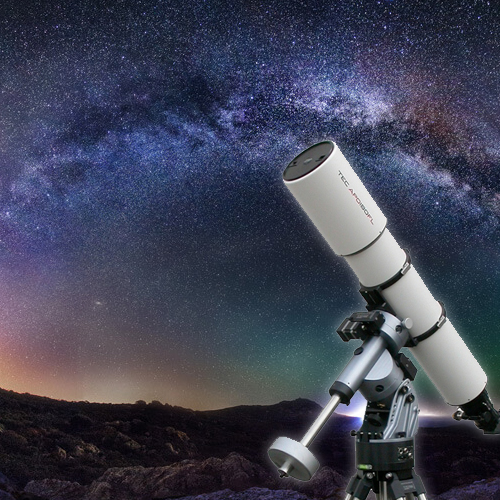
Highs
- Sharp & Contrasty views
- Astrophotography
- Visual Astronomy
- Highest end optics
- Hold their value
Lows
- Pricey
- Hard to find
- Backordered
Where To Buy
Why use Fluorite glass in a telescope?
What's the big deal with Fluorite glass in a telescope anyway?
While a TEC 140 review for this new model doesn't exist yet. We can tell you why fluorite glass is highly valued in telescope manufacturing because of its exceptional optical properties, which make it ideal for high-performance lenses like those in TEC (Telescope Engineering Company) telescopes. Here’s why fluorite glass is such a good choice and why TEC uses it:
1. Superior Optical Clarity
- Fluorite (CaF₂) has an extremely low refractive index compared to traditional glass. This allows it to transmit light with minimal scattering, resulting in remarkably clear and sharp images.
2. Minimal Chromatic Aberration
- One of fluorite’s standout features is its ability to reduce chromatic aberration, a distortion where colors fail to converge at the same point. This makes it ideal for apochromatic (APO) lenses, producing images with accurate color and sharp detail, especially important in astrophotography and visual astronomy.
3. High Light Transmission
- Fluorite glass has excellent light transmission properties, allowing telescopes to maximize the amount of light captured, which is critical for observing faint celestial objects.
4. Thermal Stability
- Fluorite exhibits low thermal expansion, meaning its optical performance remains stable even under varying temperatures, ensuring consistent results during long observation sessions.
Why TEC Uses Fluorite Glass:
TEC incorporates fluorite glass in their refractors to achieve the highest optical performance for discerning astronomers and astrophotographers. They use it to:
-
Deliver Premium Quality: TEC aims to create telescopes that are among the best in the industry, and fluorite glass helps them achieve unmatched clarity, contrast, and resolution.
-
Optimize for Color Correction: Fluorite is central to their apochromatic doublets and triplets, which eliminate virtually all chromatic aberration, providing precise and vibrant views of celestial objects.
-
Meet Demanding Standards: TEC caters to serious enthusiasts and professionals who demand flawless performance. By using fluorite, TEC ensures their telescopes produce images with exquisite sharpness and minimal distortion.
-
Maintain Their Reputation: TEC’s dedication to excellence and their use of fluorite glass solidify their reputation as leaders in the premium refractor market. Fluorite-based optics align perfectly with their mission to create instruments that push the boundaries of what’s optically possible.
Why is Flourite so expensive?
Fluorite glass, prominently used in premium telescopes from brands like Takahashi, TEC, and Astro-Physics, is a testament to the principle that you get what you pay for. Its unmatched optical performance and precision come at a cost, but there is no substitute for excellence in optics. For those seeking the pinnacle of clarity and accuracy, the investment is well worth it.
1. Material Properties
- High Optical Performance: Fluorite glass has exceptional light transmission, low dispersion (low Abbe number), and excellent chromatic aberration correction. These properties make it ideal for high-performance optics like telescopes, camera lenses, and binoculars.
- Rare Material: Fluorite (calcium fluoride, CaF₂) is a natural mineral that needs to be of very high purity for optical applications, and such material is rare and costly to source.
2. Manufacturing Challenges
- Complex Processing: Fluorite is brittle and challenging to work with. It requires careful handling, precise grinding, and polishing during production, which increases labor costs.
- Specialized Coatings: To enhance performance, fluorite lenses often require anti-reflective coatings or other treatments, adding to the cost.
3. Limited Supply Chain
- The supply of high-quality fluorite suitable for optics is limited. Mining and refining processes are costly and time-intensive.
- Many fluorite lenses are made by highly specialized manufacturers with limited production capacity.
4. Applications in High-End Optics
- Fluorite glass is used in high-end astrophotography telescopes, premium camera lenses, microscopes, and scientific instruments. These industries demand precision and quality, which drives up prices.
5. Substitutes Are Still Costly
- While synthetic alternatives like fluorite-like ED (Extra-low Dispersion) glass exist, they mimic but do not fully replicate the performance of true fluorite. These alternatives also have their production challenges and costs, keeping the price of premium optics high.
Fluorite’s rarity and the precision required in its use make it a luxury material in optical engineering, often reserved for applications where performance justifies the expense.


| Founded | Employees | Social | Traffic |
|---|---|---|---|
Telescope Engineering Company began in 1994 as a distributor/subcontractor of optics and optical materials.
View more about Telescope Engineering Company (TEC)