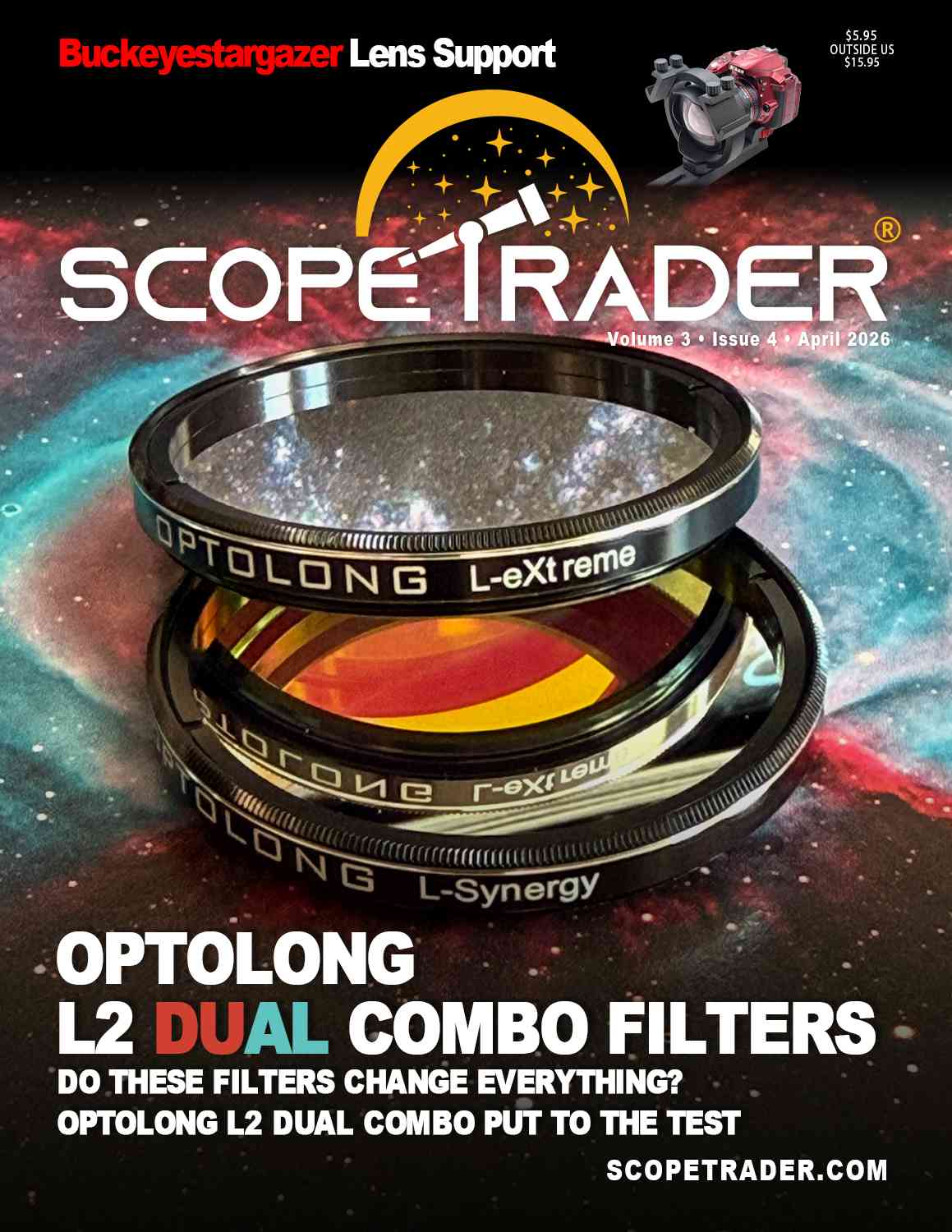
ScopeTrader April 2026 Cover


Subscribers, please Login to read now.

Don't have a subscription to the best Astronomy gear & news magazine on the planet?

Get instant access to this issue with your subscription.

ScopeTrader April 2026

April 2026 comes back to a question most of us ask sooner or later. What actually improves your astrophotography, and what just adds complexity without real gain.

A practical look at the Optolong L2 Dual Combo Filters in real imaging The lead story focuses on the Optolong L2 Dual Combo Filters with a hands on review across multiple targets and setups. This is not theory. It is how these filters perform with mono SHO workflows and one shot color cameras, what kind of signal you actually get, and where they simplify or complicate your process. If you are trying to reduce filter changes without giving up control, this piece lays out the tradeoffs clearly.

Stability and support where it counts We also look at the Buckeyestargazer lens support system and why proper support matters more than most people think. Solid mounting, clean balance, and cable routing show up directly in your stars. Small changes here can fix problems that no amount of processing will solve later.

Using more of the data you already have SpacePixels offers a different way to think about your data by turning discarded frames into something useful. Instead of ignoring streaks and trails, you can start to extract information and even contribute to real findings.

Mounts, workflow, and the rest of the system The Watusi 150 equatorial fork mount brings a different approach to balance and setup, while the ASCOM Flat Panel Buddy focuses on making calibration consistent and simple. We also cover the Delta Pier tripod for field stability, take a look at the MOTHRA multi lens array, and step through Artemis II with practical guidance on how to follow it yourself.

This issue stays focused on what holds up in practice. If it helps you get better data with less friction, it earns its place.


Get more issues of ScopeTrader


ScopeTrader April 2026 ScopeTrader March 2026 ScopeTrader February 2026 ScopeTrader January 2026 ScopeTrader December 2025 ScopeTrader November 2025 ScopeTrader October 2025 ScopeTrader September 2025 ScopeTrader August 2025 ScopeTrader July 2025 ScopeTrader June 2025 ScopeTrader May 2025 ScopeTrader April 2025 ScopeTrader March 2025 ScopeTrader February 2025 ScopeTrader January 2025 ScopeTrader December 2024 ScopeTrader November 2024 ScopeTrader October 2024 ScopeTrader September 2024 ScopeTrader August 2024 ScopeTrader July 2024 ScopeTrader June 2024

Latest Video


AM7 Mount Replaces CGX-L


Recent Topics


Ghost in the dome
Started By moonbeam on 3/22/2026 7:53:39 AM
A shoutout to the talented women of astrophotography today!
Started By moonbeam on 3/8/2026 8:18:35 AM
Astrophotography and the cold, pro tips article
Started By moonbeam on 3/4/2026 3:49:38 PM
Why We Photograph the Cosmos and What It Teaches Us About Ourselves
Started By moonbeam on 2/19/2026 7:54:57 AM
ZWO AM7 Review
Started By moonbeam on 2/16/2026 2:38:12 PM
Classified Listings
Started By manfrednasa on 2/11/2026 3:14:57 PM
miniCam8 review plus more inside our February 2026 issue!
Started By moonbeam on 2/4/2026 9:01:24 AM
ZWO teases AM7 release!
Started By moonbeam on 1/26/2026 11:24:43 AM
Another Aurora!
Started By spazmagi on 1/19/2026 1:28:43 PM
StellarMate problems made me switch back to ASIAIR
Started By moonbeam on 1/12/2026 11:04:05 AM

Astronomy Picture of the Day

2026-04-05
NGC 3310: A Starburst Spiral Galaxy
NGC 3310: A Starburst Spiral Galaxy - 2026-04-05 - Image by AAO ITSO Office, 
Gemini Obs./AURA & 
T. A. Rector 
(U. Alaska Anchorage) (NASA Astronomy Picture of the Day)
Image Credit: AAO ITSO Office, Gemini Obs./AURA & T. A. Rector (U. Alaska Anchorage)
The party is still going on in spiral galaxy NGC 3310. Roughly 100 million years ago, NGC 3310 likely collided with a smaller galaxy causing the large spiral galaxy to light up with a tremendous burst of star formation. The changing gravity during the collision created density waves that compressed existing clouds of gas and triggered the star-forming party. The featured image from the Gemini North Telescope shows the galaxy in great detail, color-coded so that pink highlights gas while white and blue highlight stars. Some of the star clusters in the galaxy are quite young, indicating that starburst galaxies may remain in star-burst mode for quite some time. NGC 3310 spans about 50,000 light years, lies about 50 million light years away, and is visible with a small telescope towards the constellation of Great Bear Ursa Major.

Featured Stories


ASCOM Platform 7.1 Update 2 Released
ASCOM Platform 7.1 Update 2 Released Tuesday, February 10, 2026


Stay Updated

Sign up for our newsletter for the headlines delivered to you

SuccessFull SignUp


Get More Astronomy News →