

Astrophotography
Imaging with a Barlow: The Tortoise or The Hare
Friday, June 19, 2026

|
Peter Rejto |

Imaging with a Barlow explores how the Astro-Physics BARADV can increase image scale and sampling for deep sky astrophotography, showing when a slower setup may still deliver useful detail on brighter targets. So which one the tortoise or the hare?
'It is a nice image, Peter. But, it is kind of an unusual approach, everyone wants faster vs slow (f14) for deep sky" ...Yuri Petrov, TEC
While having dinner recently I remarked to my wife that I would probably start my write up about my experiments using a barlow (the BARADV made by Astro-Physics) and deep sky imaging. My lovely provocateur wife asked how I intended to title the article? I said, "maybe Deep Sky Imaging With a Barlow." "Boring" she said without hesitation. Both of us being musicians a lot of silly ideas were floated such as "Barlow Ballad in C# minor" You get the drift! Then she said, why are you even doing this? Why not keep the idea to yourself and just take photos with that whatchamacallit-thingamajiggy. I said the spirit of this hobby is to share. And then she said, "the spirit of this hobby is to be a home wrecker!"
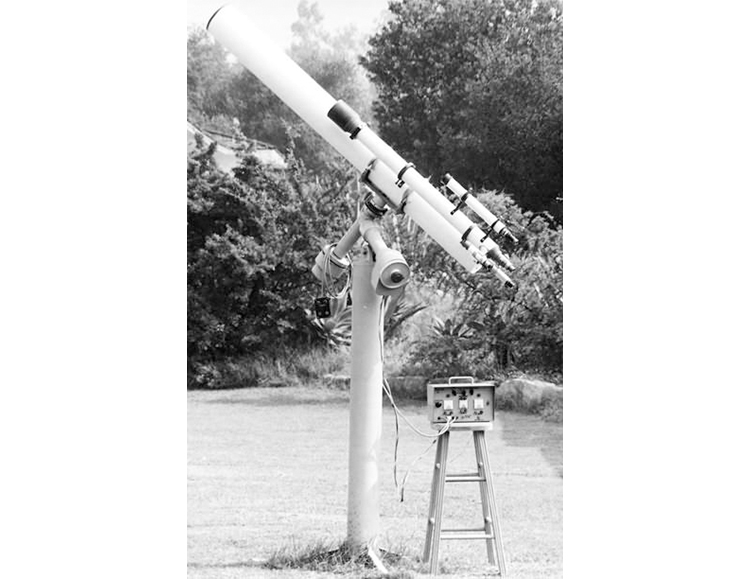
Joking aside, my obsession with big refractors started in high school in Los Angeles in the mid 1960s. The OTA in the photo (housing a 5" F15 objective) is sitting on a Cave Astrola EQ Mount with a synchronous motor and home made speed controller. With this telescope I attempted to image with a SLR and developed and printed printed in a dark room. I used either Tri-X (large grains/fast) or Panatomic-X (fine grain/slow) depending on the target and brightness and this has a direct bearing on a later discussion about sampling and pixel size in CCD and CMOS cameras. Those were the days - though I can't say I miss the smell of fixer!
Jump forward to 2005 following a migration to Australia. With considerable free time on my hands my obsession with astronomy went into full gear and within a few years I had a TEC140 and a Paramount MX mount. Because I had tried to image the moon and planets with my old refractor my new astrophotography journey started similarly....a barlow and a video camera. While researching barlows I happen upon the Astro-Physics website and read about the BARADV. I bought one and used it for planetary photography until that bug passed. It was clear that a 5" refractor even at F14 or higher was not going to cut it. My interest turned to deep sky and the barlow went into a drawer!
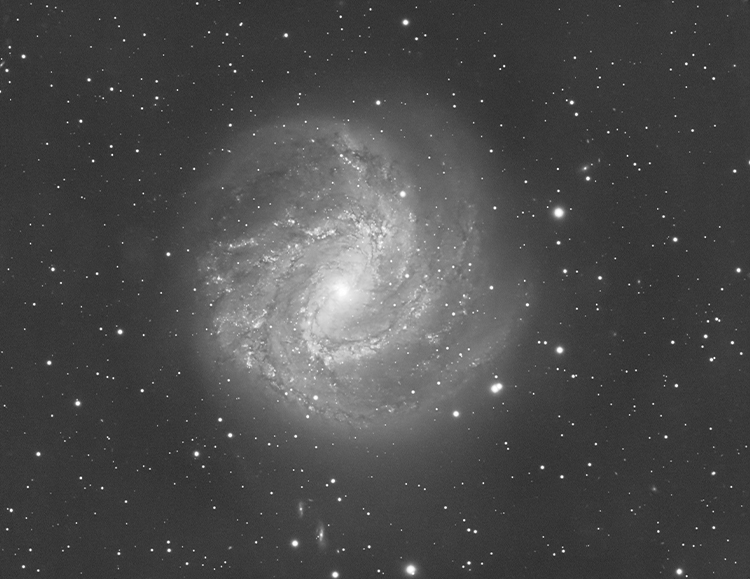
While preparing this paper I remembered that I'd taken an image of M83 back in 2013. What I didn't remember was that I actually used the BARADV on my TEC140. Light pollution and lack of processing skill saw the barlow returned to the drawer! However, I have resurrected the luminance data with the wonders of certain modern tools in Pixinsight and I was able to process the image below. This was taken with a Moravian G2-8300 camera from North Curl Curl, NSW working at ~F13.5 or 1932 mm with a resolution of .588 arc-sec. (At the native resolution of F7, this camera would yield a resolution of 1.14 arc-sec.) The data set is ~4.5 hrs of luminance using an Astronomik CLS filter. Given the huge amount of light pollution and short total time I think the image is reasonably good:
The BARADV
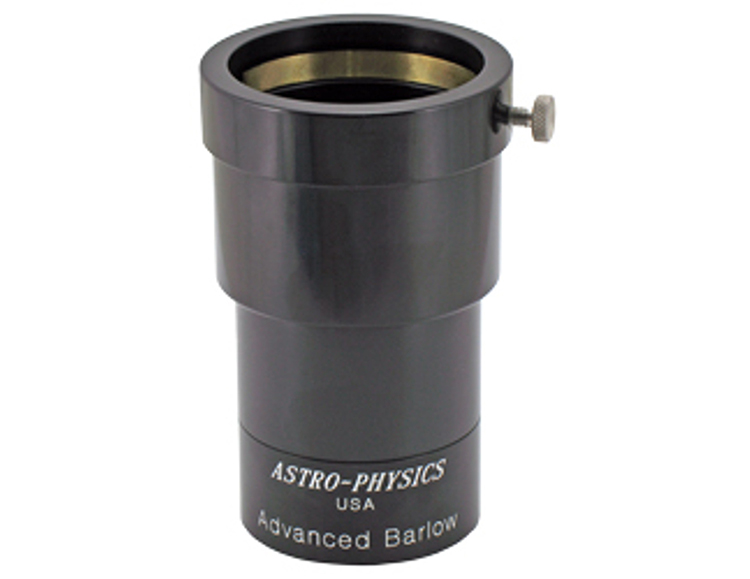
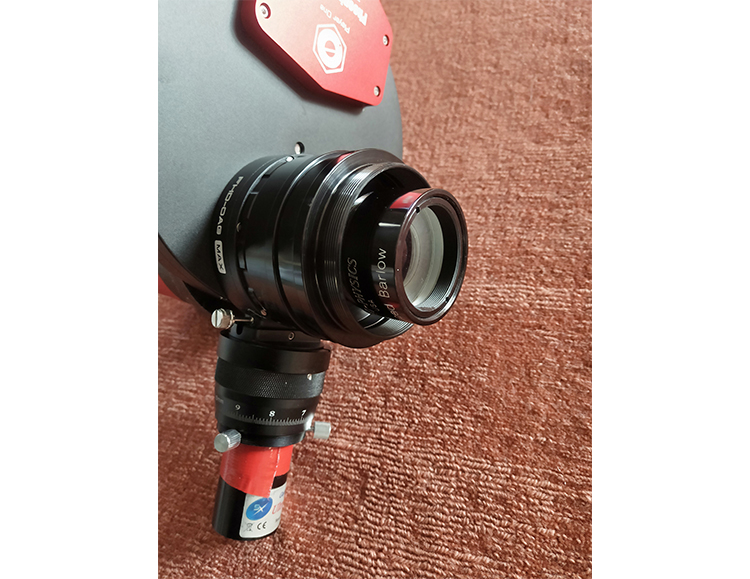
After an 11 year barlow hiatus - and while my TEC180 was recently out of service - my trusty Moravian G2-8300 camera on my TEC140 decided to up and die. I was in a position where I didn't have proper fittings to use a flattener with my only working camera, a Starlight Xpress Trius SX694. After wasting valuable imaging time doing nothing I remembered the BARADV and the fact that no flattener was required! I quickly put together a simple setup with the barlow ~ 90mm from the CCD:
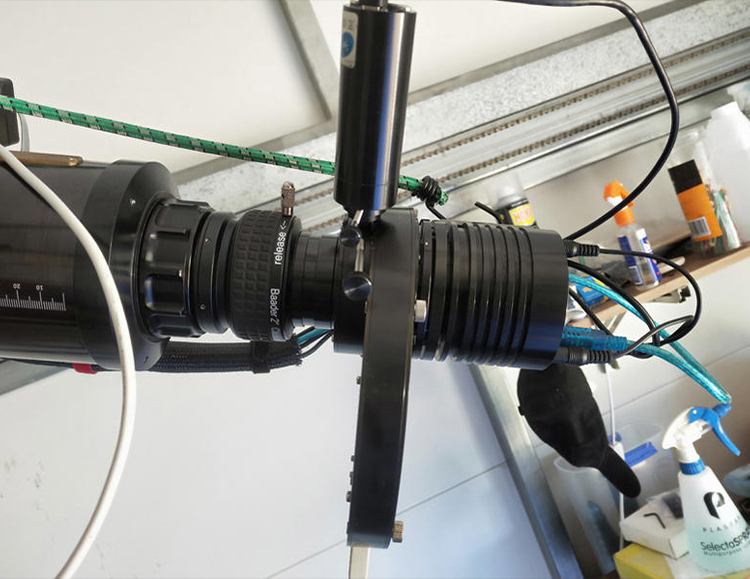
The barlow T-threads fit directly into the SX OAG and the 2" barrel of the BARADV was held securely with a Baader Quick-Lock to the focuser.
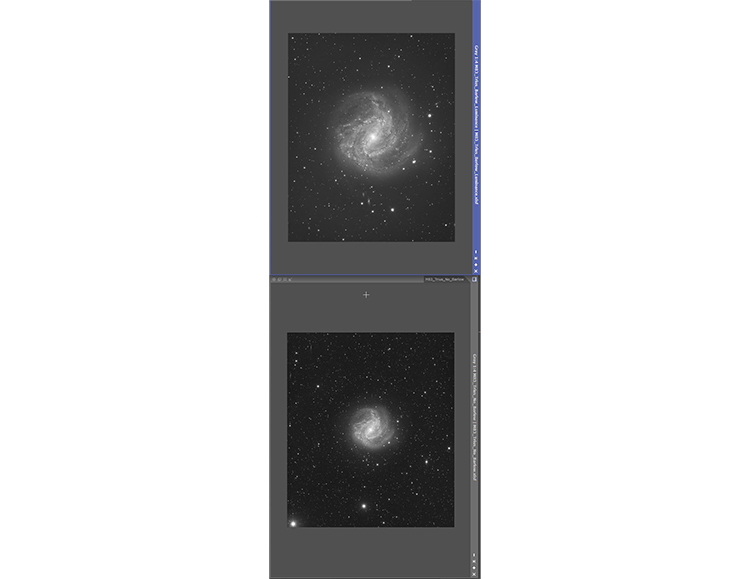
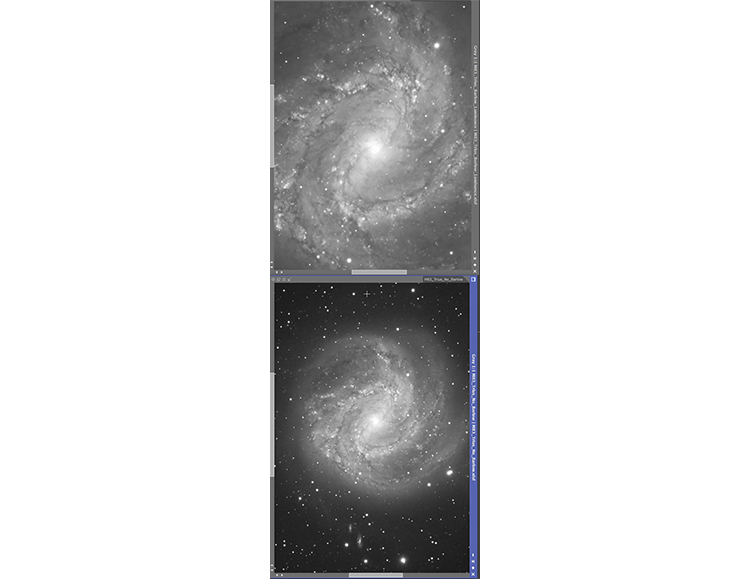
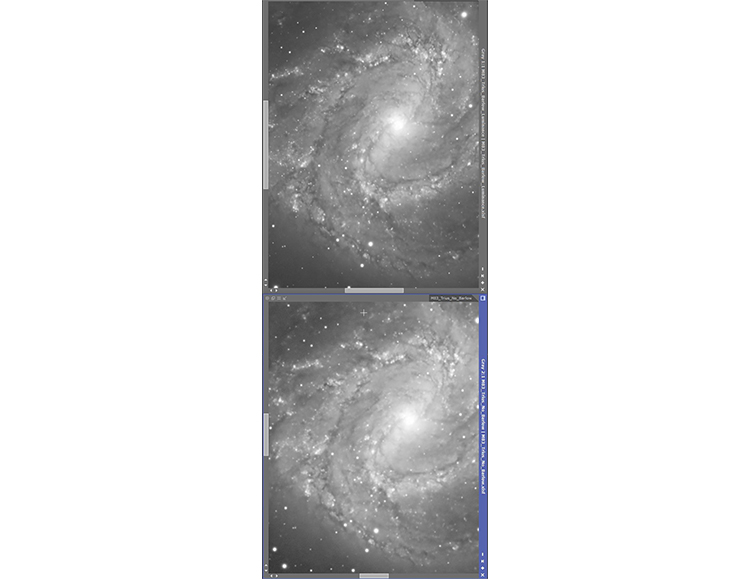
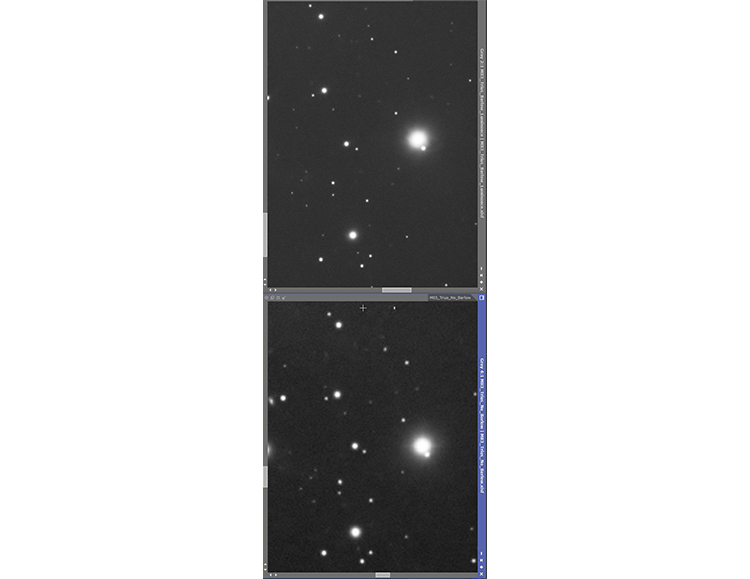
The first image I generated was of M83. Fortunately I had taken 1 hour of RGB at F7 before starting again with the BARADV at F14. It provides interesting comparisons between the two systems!
The first image below compares the fields of view - F7 vs F14
The second shows both images 1:1
The third shows F14 at 1:1 and F7 at 2:1 (i.e., same magnification)
The forth shows bright stars at similar magnification
DISCUSSION
At first glance the differences are not striking. Both images look good at 1:1, and obviously the F14 image scale is very nice and large! I would need a TEC280 @F7 (which doesn't exist, and if it did, would cost a fortune) to equal this focal length with a refractor. When inspecting the 1:1 (F14) with the F7 image at 2:1 giving equal magnification, it becomes clear that the F14 image has somewhat more detail. This becomes quite visible in the 4th image where clearly the double star has greater resolution and is not pixelated as is the F7 image at this magnification.
THEORY
The TEC140 has a theoretical maximum resolution of .81 arc-sec which would only be realised if the atmosphere vanished. In most every situation ground based telescopes cannot achieve theoretical resolution and will be limited by seeing. In other words if the sky is 1.5 arc-sec that is the absolute best resolution one can hope for and that assumes perfect tracking and guiding. Adding a barlow does nothing to change theoretical resolution, and in fact, if not well made may potentially reduce resolution. However, does it matter if resolution is not increased when the sky is the limiting factor?
There are two positives and one negative to imaging in this manner. One is obviously increased image scale which is quite satisfying for smaller targets. The second is greater sampling due to the increased focal length. The negative is that the brightness of the image falls by a theoretical factor of 4 when doubling the focal length.
I'm no theorist and this experiment started without any theoretical impetus to drive it. There is much that can become argumentative quickly when getting into the theory. Hopefully, I won't sink into quicksand! In a nutshell, my understanding is that there is a theory by Nyquist that states that for an analog signal to be digitized, it must be sampled at 2x or more of the bandwidth. In simplistic terms, at a minimum, in two arc-sec sky sampling should be at least 1 arc-sec. When I first got my TEC140 the camera I chose (KAF-8300 CCD) provided 1.14 arc-sec resolution -which is close to the Nyquist recommended 2x resolution for imaging in average 2 arc-sec conditions. However, the sky can certainly be better than 2 arc-sec, and the theory says 2x or more for sampling. Today the thinking seems to be that ideal is actually closer to 3-3.5X. Therefore, to properly sample in 1.5 arc-sec sky one would aim for .5 arc-sec resolution. My SX Trius (ICX694) camera at F14 on my TEC140 yields an imaging scale of .48 arc-sec. Not long ago this resolution might have seriously thought to be over sampled. Today, thinking has shifted. Modern CMOS cameras are extremely quiet and with very high QE compared to most older CCDs. The dimmer image can be managed without becoming lost in the noise. Even the older generation KAF-8300 did rather well on M83, though admittedly this target is rather bright. Also, sharpening via deconvolution certainly appears to work better with 3x sampling.
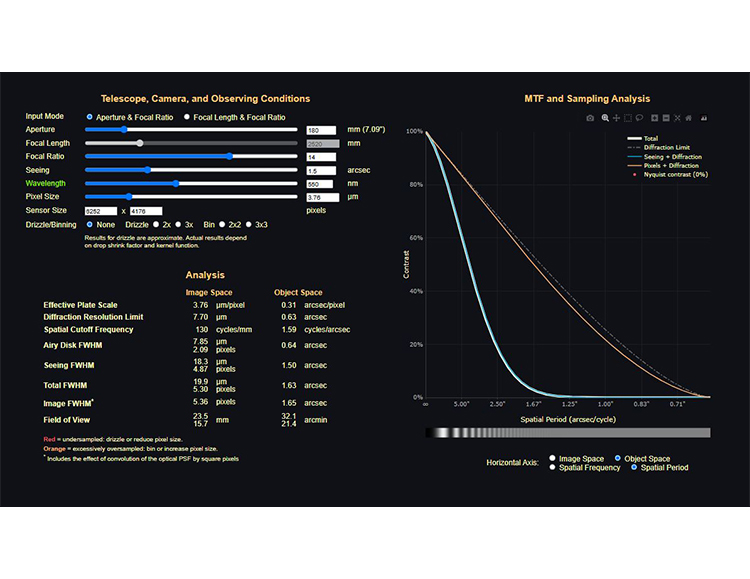
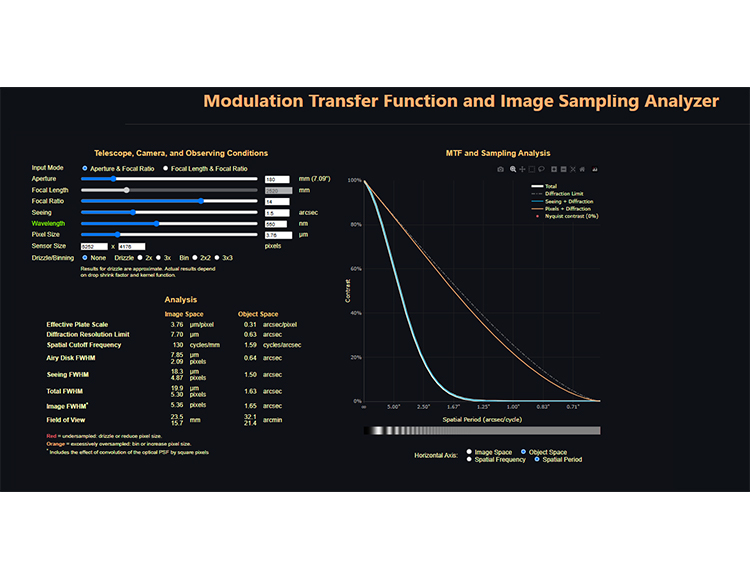
Russel Crowman, of BlurX fame, has an extremely useful page where he has put up a Modulation Transfer Function (MTF) and Image Sampling Calculator. Data for any camera and OTA can be uploaded and the results immediately viewed. Below is the setup for both my TEC140 at F7 and at F14. Notice how the calculator shows under sampling at F7 even with rather small 4.54 micron pixels of the SX Trius camera.
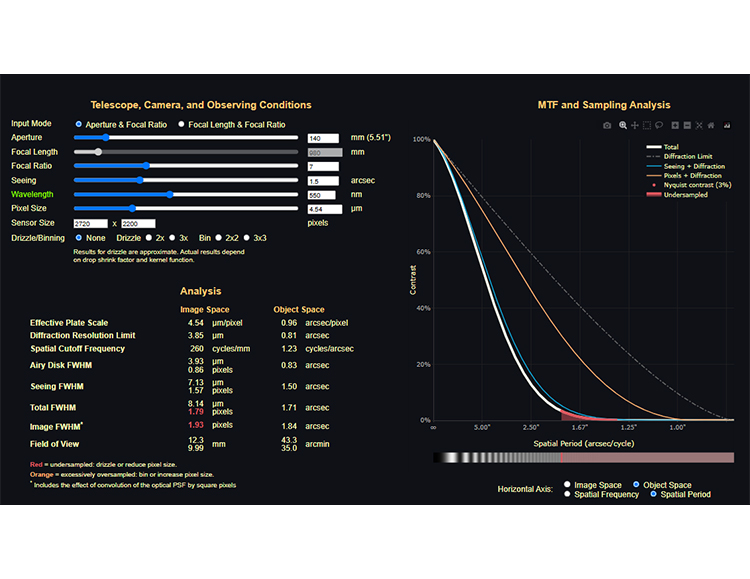
The term "Image FWHM" indicates the best case resolution under 1.5 arc-sec sky that can be obtained: 1.84 arc-sec @ F7. Notice that the image resolution is always worse than the seeing.
At F14 this falls a bit to 1.75 arc-sec. Thus, even though adding a barlow does not improve the theoretical resolution, it can potentially result in a slightly improved image resolution, all things considered.
Also of note is that the theoretical resolution of .81 arc-sec remains far from obtainable even in great sky conditions. It is instructive to play with the seeing value and note what conditions would be necessary to approach the theoretical resolution.
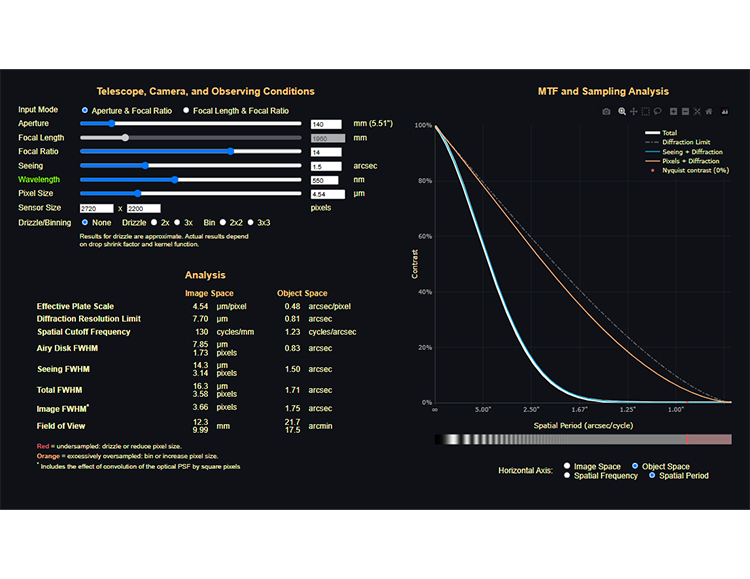
The barlowed F14 setup is ideally sampled compared to the usual F7 setup.
I was in correspondence with Russ Crowman about this and he wrote the following that I use with his permission:
Some rambling thoughts...According to the MTF analyzer results on your setup, sampling is pretty much ideal, even for nights with excellent seeing. It's similar to shooting at native f/7 but drizzling 2x, except you don't have the inherent resolution loss due to pixel convolution. M83 is fairly bright, giving good SNR - that's usually the biggest determinant of how well any deconvolution algorithm can work.Your native resolution with this setup is basically entirely dominated by seeing. At the same SNR, a big scope vs. a small scope will produce similar deconvolved results if they are both seeing-limited. The "same SNR" part is the catch - the big scope will generally be able to achieve a certain SNR in less exposure time, presuming pixel size is scaled to match the change in focal length (e.g., with binning).I'm seeing similar deconvolved results in terms of resolution with my FSQ-106, drizzled 2x, as I did with my 14" RC back in the day, e.g., fully resolving the "E" star in the Trapezium cluster. Above some aperture, all of our setups are seeing-limited, and smaller scopes perhaps have the advantage of looking through fewer atmospheric cells as you mentioned.
The old advice regarding sampling was 2-3 pixels stellar FWHM. These days it's more like 3-4 pixels, so not quite double. More than 4 pixels FWHM isn't harmful, but doesn't gain anything. Deconvolution can't overcome fundamental limits such as the Nyquist sampling theorem. In part I'm hesitant to use "doubling" anywhere because I already see a lot of users excessively oversampling images, with FWHM values greater than 8 pixels. Often 2x drizzling is used to get there, and it's a complete waste of time, disk space, and processing power.
Best,Russ
Russ mentions a topic not yet discussed, namely why one commonly hears of situations where a smaller aperture in poorer seeing conditions "might" out perform the larger aperture. Visual astronomers comment about this frequently. The reasoning is highly debatable if one puts validity into certain Cloudy Nights Forum discussions! Nonetheless, the frequently used rational for this outcome hinges around the idea of atmospheric cell sizes generally being in the 6-8" size, thus having less effect on a smaller aperture than a larger aperture where more cells moving horizontally over the lens may have the potential to distort the incoming light.
There is an interesting discussion at CN following the posting of a Question: "Is it better to gain increased resolution by doubling the focal length, or to drizzle by 2x?"
What follows is a very interesting and often technical debate. After a page or so the debate morphs more towards reducing the pixel size X2 (rather than drizzling) The conclusion was essentially that doubling the FL was better, but practical considerations mostly around cost of equipment (OTA and larger mount) often preclud this solution. Of course, doubling the number of pixels is also not inexpensive!
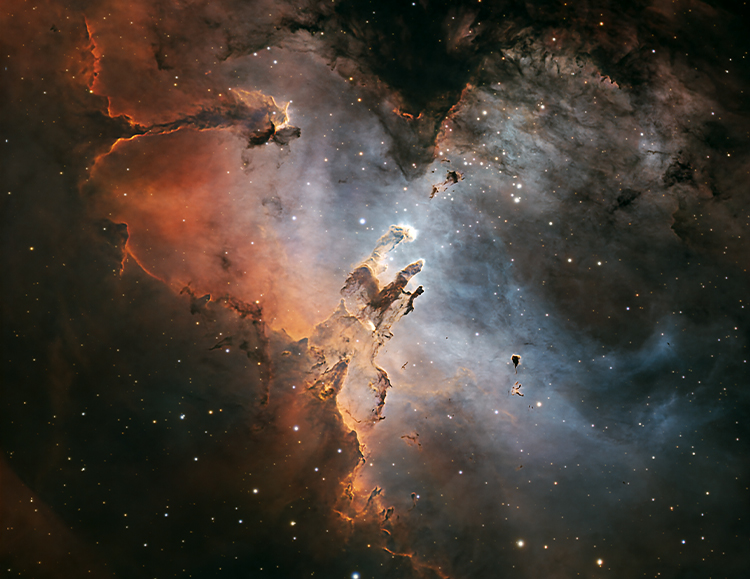
I noticed not a single mention of a barlow. Obviously there is a long standing prejudice against the use of any slower system where barlows are only "allowed" for bright objects (moon and planets) and lucky imaging. For a few hundred dollars one can increase scale size, increase potential image resolution (modestly) and increase sampling. The cost is in imaging time and the increased possibility that as targets get dimmer, the cost in terms of time and noise may become too great. However, my second photo with a barlow was of M16 and I managed to get decent signal with 30 min subs for OIII and SII. I suspect the setup would be okay for certain planetary nebula, though this is just speculation at this point.
To conclude this part of the discussion I will quote a wise participant on the Cloudy Nights Forum:
"Welcome to the analysis paralysis of CN. Get a scope, get a camera, and go have fun."
This is certainly the way I approached this project. I thought why not give this a try? Roland Christen. a world class designer of refractors, is obviously a very smart guy. Why are astro-photographers ignoring the results he posted on the Astro Physics website about the use of the BARADV?
For a very detailed presentation about deconvolution, drizzling, sampling, Nyquist theory, etc I highly recommend viewing this video at RC-Astro.
MECHANICS
The BARADV can produce good stars up to an APS-C size chip. The mild distortion at corners is easily corrected with BlurX.
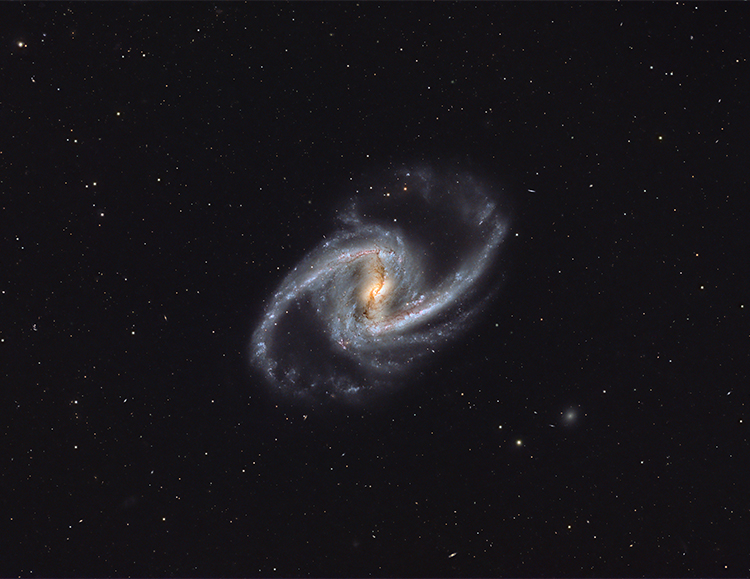
Here is more detailed information about my setup with the BARADV. This is the setup I used with a Player One Poseidon M, Filter Wheel and Player one OAG. (photo of NGC1365. The other two photos were with an SX Trius 694, SX FW and OAG. I did not use the BH27 int42 discussed below)
On the AP website there is a page that discusses back focus distances. The larger the BF the larger the magnification. The sweet spot seems to be around 2X at ~90mm.
It's worth noting that the back focus distances for the BARADV are not very critical with only small shifts in power over large adjustments in spacing. Flatteners should be be removed because this barlow provides some flattening that regular barlow lenses do not.
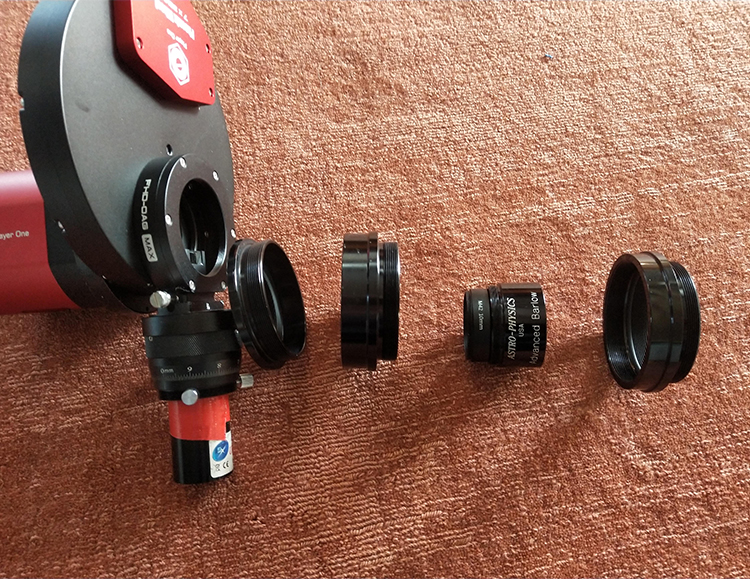
These are parts that I used to setup the BARADV on my TEC-180 (photo of NGC1365)
Player One OAG with a 54mm female ring that came with the camera package
AP part ADA27-54 - screws into OAG and provides 2.7" threads
AP part BH27-INT42 screws into ADA27-54 and provides internal threads to hold BARADV via t-threads (42mm) This supports the barlow; the 2.7" threads hold camera weight.
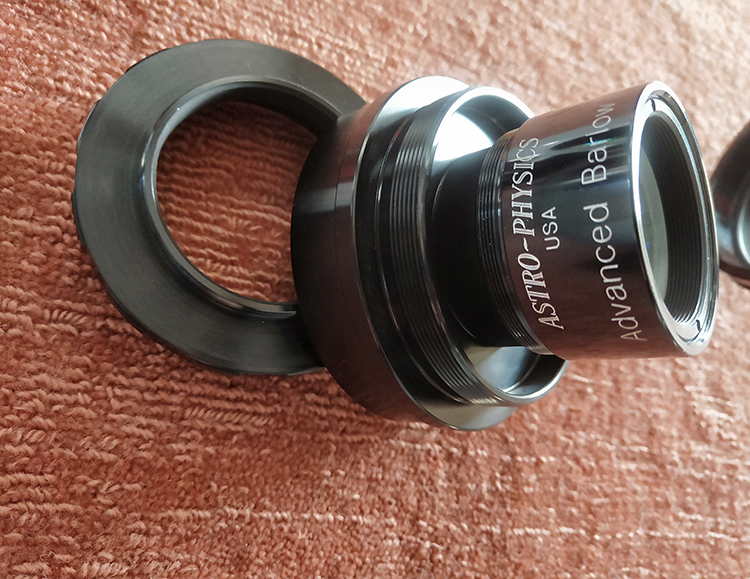
AP part BARADV
10mm T-thread extender (placed between the BARADV and BH27-INT42
AP part EXT27-64.8 This mates the assembly to my FT focuser (available in different lengths depending on focuser travel to reach focus)
Starlight Instruments: EC35-505AP End Cap 3.5" for Astro-Physics Telescopes (i.e., 2.7" threads)
---------------------------------------------------------------------------
Going forward I will be using a setup with an ONAG in order to have a larger field of guide stars (and for automated focusing). Speaking of guiding, certainly guiding at longer focal lengths presents certain issues of fewer guide stars but also tracking. For the image on NGC1365 I binned my guide camera x4.
---------------------------------------------------------------------------
Takahashi also makes extenders for their telescopes. Apparently they provide excellent corrected images that may exceed the BARADV and can be used for imaging. The back spacing appears to be long enough for a camera system as typically the extender is mounted before an eyepiece diagonal.
Imaging is mentioned as a possibility in this thread
Here is an example of a planetary nebula photographed with a 1.6x Tak extender of an FSQ130ED
A discussion at the Stargazer's Lounge from 2019 claims that the extender distorts too much for a chip with a 21.6mm2 sensor. I believe BlurX would easily address this concern.
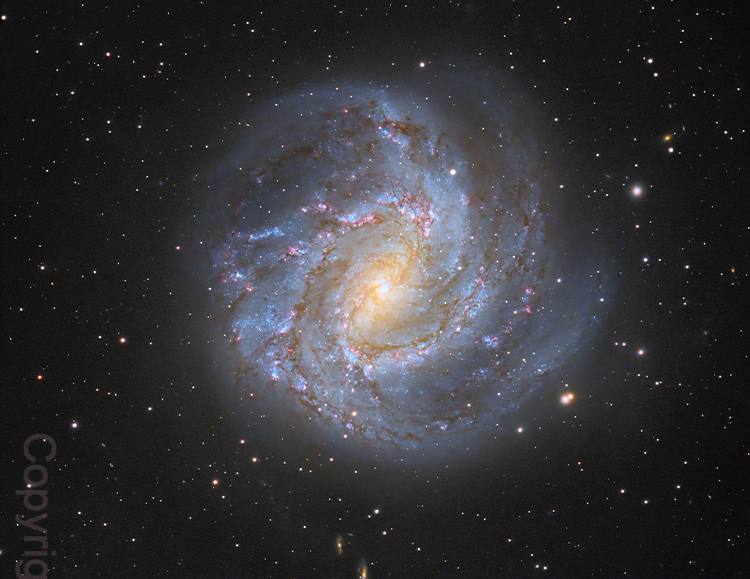
IMAGING RESULTS
4.6 hours total LRGB 300 sec subs
49.5 hours total SII and OIII 1800 sec subs
10 hours total of LRGB 480 sec subs
Conclusion
I believe that I have demonstrated a cost effective way to increase image scale and sampling using the Astro-Physics BARADV. For shorter focal length systems this barlow will potentially give a better result than drizzling X2 and is far less costly than replacing a camera or investing in a longer focal length system and all the associated expenses of a heavier mount, etc. The cost for the use of a barlow is somewhat increased imaging time which for those imagers with permanently set up observatories may be a non-issue. For those setting up nightly the increased imaging time on dimmer targets may make this solution impractical, however, on brighter targets with a modern camera the increase may be very modest and barely noticed.
Peter Rejto
This content is made possible by a guest author, or sponsor; it is not written by and does not necessarily reflect the views of ScopeTrader's editorial staff.
- DRAFT COPY ONLY -