You searched for "supermassive black hole"


8 supermassive black hole astronomy news items found


Star-eating-black-hole-spotted-by-Hubble-and-Chandra

Star eating black hole spotted by Hubble and Chandra


Wednesday, July 30, 2025 by

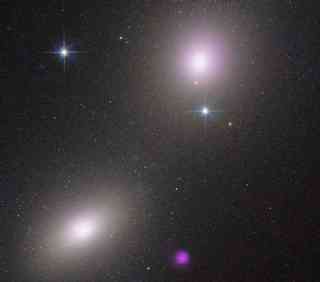
NASA’s Hubble Space Telescope and the Chandra X-ray Observatory have collaborated to identify a potential example of an elusive category of black holes. Known as NGC 6099 HLX-1, this luminous X-ray source appears to be located within a compact star cluster on the outskirts of a massive elliptical galaxy. Image credit: NASA, ESA, CXC, Yi-Chi Chang (National Tsin...


Black-hole-moving-spotted-by-Hubble

Black hole moving spotted by Hubble


Monday, May 12, 2025 by

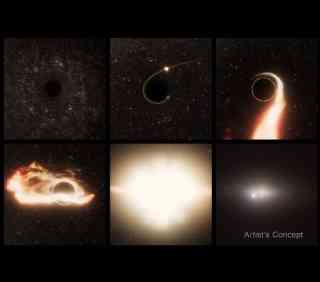
Like a scene out of a sci-fi movie, astronomers using NASA telescopes have found “Space Jaws.” Lurking 600 million light-years away, within the inky black depths between stars, there is an invisible monster gulping down any wayward star that plummets toward it. The sneaky black hole betrayed its presence in a newly identified tidal disruption event (TDE) ...


Phoenix-galaxy-cluster-mapped-by-Webb

Phoenix galaxy cluster mapped by Webb


Thursday, February 20, 2025 by

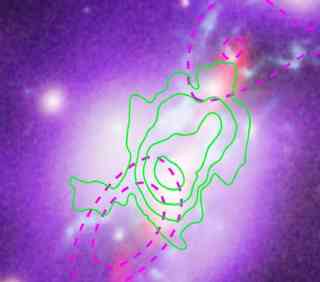
Researchers using NASA’s James Webb Space Telescope have confirmed how a massive galaxy cluster sustains high rates of star formation, resolving a long-standing mystery. This finding builds on more than a decade of studies conducted with NASA’s Chandra X-ray Observatory and Hubble Space Telescope, along with several ground-based observatories. Image credi...


Andromeda-galaxy-survey-unveiled

Andromeda galaxy survey unveiled


Saturday, January 25, 2025 by

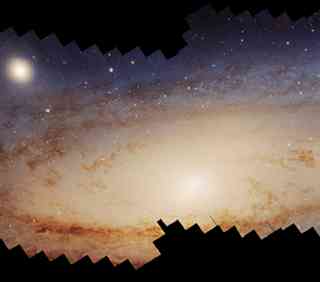
On a clear autumn night, the farthest object visible to the naked eye can be seen without a telescope or binoculars. Located just northeast of the Great Square of Pegasus, it appears as a spindle-shaped haze with a bright center. This object is the Andromeda galaxy, the nearest galaxy to the Milky Way. The faint light from Andromeda left the galaxy 2.5 million years ago...


Closest-quasar-observations-by-Hubble

Closest quasar observations by Hubble


Monday, December 9, 2024 by

Amateur astronomers can search for a unique starlike object, known as 3C 273, which holds the record as the farthest target observable from Earth through a common-sized backyard telescope. Because 3C 273 radiates the light equivalent of trillions of suns, it can be seen over two billion light-years away. Today, it is known as the blinding bright core of an active galaxy...


Supermassive-black-hole-duo-found-by-NASAs-Hubble-Chandra

Supermassive black hole duo found by NASAs Hubble Chandra


Thursday, September 12, 2024 by

For all practical purposes, stars traveling across space never smash into each other. The ratio between a starlike sun's diameter and its distance to the next neighboring star is about 1:10 million. Galaxies do collide though. The separation between our Milky Way and neighboring Andromeda galaxy is a staggering 2.2 million light-years. That's a ratio of only 1:2...


JWST-reveals-dust-in-a-galaxy-70-million-light-years-away

JWST reveals dust in a galaxy 70 million light years away


Sunday, August 11, 2024 by

Researchers at Newcastle University, using the James Webb Space Telescope (JWST), uncovered a dust veil in galaxy ESO 428-G14, 70 million light years away. Contrary to expectations, the dust is heated by gas collisions rather than radiation from the supermassive black hole. JWST reveals dust near a supermassive black hole This discovery highlights the complex...


Supermassive-black-holes-are-merging-in-the-galaxy-system-ZS7

Supermassive black holes are merging in the galaxy system ZS7


Tuesday, May 21, 2024 by

Astronomers have provided evidence for an ongoing merger of two galaxies and their massive black holes when the universe was just 740 million years old, using observations from the James Webb Space Telescope (JWST). This groundbreaking discovery highlights a significant period in cosmic history, revealing the farthest and earliest detection of merging black holes to dat...


Astronomy Picture of the Day

2026-04-03
Caught in the Web: Visualization of a Black Hole Merger in the Tarantula Nebula
Caught in the Web: Visualization of a Black Hole Merger in the Tarantula Nebula - 2026-04-03 - Image by Carl Knox (NASA Astronomy Picture of the Day)
Image Credit: Carl Knox
How can we see what is invisible? Black holes are not easy to see in the dark cosmic night, but astronomers can find them by analyzing their gravitational effects on matter, light and spacetime. The featured image shows an illustration that combines a simulation of a black hole binary system in its final "death-dance" with an astrophotography image of the Tarantula Nebula in the background. Even though black holes don't emit light, they distort the path of light rays, acting like a gravitational lens. As a result, the nebula appears extremely distorted, forming Einstein rings and multiple images. Tarantula Nebula lies in the Large Magellanic Cloud, a dwarf galaxy that is one of the satellite galaxies of the Milky Way, 160,000 light-years away. That is more than 1,000 times closer than any of the binary black hole mergers detected so far. We'll probably never detect a merger so close to home!

Latest Video


AM7 Mount Replaces CGX-L


Recent Topics


Ghost in the dome
Started By moonbeam on 3/22/2026 7:53:39 AM
A shoutout to the talented women of astrophotography today!
Started By moonbeam on 3/8/2026 8:18:35 AM
Astrophotography and the cold, pro tips article
Started By moonbeam on 3/4/2026 3:49:38 PM
Why We Photograph the Cosmos and What It Teaches Us About Ourselves
Started By moonbeam on 2/19/2026 7:54:57 AM
ZWO AM7 Review
Started By moonbeam on 2/16/2026 2:38:12 PM
Classified Listings
Started By manfrednasa on 2/11/2026 3:14:57 PM
miniCam8 review plus more inside our February 2026 issue!
Started By moonbeam on 2/4/2026 9:01:24 AM
ZWO teases AM7 release!
Started By moonbeam on 1/26/2026 11:24:43 AM
Another Aurora!
Started By spazmagi on 1/19/2026 1:28:43 PM
StellarMate problems made me switch back to ASIAIR
Started By moonbeam on 1/12/2026 11:04:05 AM

Featured Stories


ASCOM Platform 7.1 Update 2 Released
ASCOM Platform 7.1 Update 2 Released Tuesday, February 10, 2026


Stay Updated

Sign up for our newsletter for the headlines delivered to you

SuccessFull SignUp


Get More Astronomy News →