
Smart Telescope
Seestar S50 Pro: A Conversation With ZWO Founder Sam Wen

Now that the Seestar S50 Pro is here, we thought it was a good time to sit down with Sam Wen, founder and CEO of ZWO. Sam is more than the person running the company. He is a software engineer, an amateur astronomer, and an astrophotographer who understands the problems his customers are trying to solve because he has dealt with many of them himself.
For our hands-on testing and imaging results, read our Seestar S50 Pro review. Here, we explore the engineering decisions behind the telescope with ZWO founder Sam Wen.
ZWO began in 2011 with a practical idea: build astronomy cameras that offered strong performance without making astrophotographers pay for technology they did not need. The early ASI130MM and the ASI120 series helped establish ZWO in planetary imaging. From there, the company expanded into cooled deep sky cameras, focusers, filter wheels, mounts, telescopes, and the ASIAIR control system. What started with cameras gradually became a connected imaging platform.
Where the Seestar S50 Pro fits in the ZWO lineup
The Seestar story began with the original S50 in 2023. It combined a 50mm refractor, camera, tracking mount, filters, computer, and image processing software in one portable package. More importantly, it allowed someone to find and photograph an object without first learning how to assemble and operate an entire astrophotography system.
The smaller Seestar S30 followed, giving users a wider field of view and a lighter travel option. The S30 Pro pushed that compact design further with improved optics, higher resolution sensors, and a second wide field camera. Now the S50 Pro brings the Seestar line back to its original 50mm roots, carrying forward what ZWO learned from each version along the way.
Clearly, Sam has a vision for where this kind of telescope is headed. With one of the most anticipated Seestar models now arriving, this seemed like the right time to ask where the idea came from, what ZWO learned from the original S50, and what Sam believes smart telescopes will become next.
Seestar S50 Pro vs. S50: What changed?
ScopeTrader: What was the original product vision for the S50 Pro? What did you want it to accomplish that the original S50 could not?
Sam: The product vision for the entire Seestar brand has always been clear: to give more people the opportunity to look up at the stars and explore the universe by lowering the barrier to astrophotography.
As part of the Seestar product lineup, the S50 Pro continues this same vision — enabling more people to easily appreciate and capture the beauty of the universe. Compared with the S30 Pro, however, it is more advanced and more powerful, with performance that comes closer to professional astrophotography equipment.
Compared with the original S50, the S50 Pro further expands both versatility and ease of use. It features both a main telephoto imaging system and a wide-angle camera. The wide-angle camera can capture wide-field subjects such as the Milky Way and star trails, while also assisting the main telescope in locating and tracking targets. For beginners, even accurately pointing a telescope at the Sun or Moon can be challenging, so improving ease of use was particularly important.
The S50 Pro also represents a comprehensive upgrade in its tripod, exterior and structural design, optics, and hardware performance. The tripod supports two operating angles, the field of view is four times that of the S50, and the optical performance has been significantly improved. Pinpoint stars and a zero-backlash drive system provide highly stable tracking, allowing users to capture impressive views of the universe while further narrowing the gap between smart telescopes and professional astrophotography systems.
Why the S50 Pro is larger than the S30 Pro
ScopeTrader: Compared with the S30 Pro, the S50 Pro gains 20 mm of aperture, but the telescope itself is considerably larger and closer in size to the original S50. Is that primarily because of the 260 mm optical path, or did the battery, motor, mount, and other components also require the larger body? What would you have had to sacrifice to make it as compact as the S30 Pro?
Sam: The S50 Pro is built around a 50 mm aperture, so it is natural that its overall size is closer to that of the S50. The primary factor determining the size of the telescope is the optical system, rather than the need to accommodate a larger battery, motor, or mount.
There is a substantial difference between a 30 mm and a 50 mm optical system. Combined with the different focal lengths, the S50 Pro's optical tube is naturally larger than that of the S30 Pro. The product first has to accommodate and support the 50 mm optical system, and the internal space for the motor, battery, and other components is then designed around it.
As a result, making the S50 Pro as compact as the S30 Pro would be extremely difficult. The most direct approach would be to reduce the aperture, but that would sacrifice the light-gathering capability of the 50 mm system and remove one of its core advantages.
S50 Pro vs. S30 Pro: Aperture and tracking advantages
ScopeTrader: The S30 Pro and S50 Pro share many of the same core features. Beyond the additional aperture, what do you consider the most important reason to choose the S50 Pro?
Sam: The S30 Pro and S50 Pro share many core features, a significant number of which are enabled by the Seestar App and software platform, including automatic target locating, live stacking, mosaicking, Milky Way panorama imaging, time-lapse photography, and more.
However, there are two key hardware differences between the products.
1. Larger light-gathering aperture
The 50 mm aperture provides greater light-gathering capability and allows the S50 Pro to capture richer image detail. A larger aperture also provides greater resolving potential. Whether observing faint structures in deep-sky objects or surface details on the Sun and Moon, the S50 Pro can reveal noticeably more detail.
2. More stable mechanical drive system
The S50 Pro uses a zero-backlash precision drive system that significantly improves tracking stability and resistance to wind. This advantage is particularly noticeable in equatorial mode, where it can substantially improve imaging efficiency.
Overall, the S50 Pro brings high-quality astrophotography within reach of a broader range of users. Whether you're an experienced astronomy enthusiast looking for finer detail or a beginner just getting started, the S50 Pro makes it easier to capture impressive deep-sky images.
Its imaging performance comes closer to professional astrophotography equipment while offering major advantages over traditional systems in portability, ease of use, and overall user experience. It represents a major upgrade three years after the launch of the original S50.
Why the Seestar S50 Pro uses a 1/1.2-inch sensor
ScopeTrader: The S50 Pro uses a 1/1.2-inch, 8.29-megapixel sensor, matching the S30 Pro in sensor size and resolution. Why pair the larger 50 mm optics with a sensor of the same format instead of moving to a larger one? Was that decision driven primarily by cost, sensor availability, or the optical design?
Sam: A larger optical aperture does not necessarily require a larger sensor. Even in traditional astrophotography, large-aperture telescopes can be paired with sensors of different sizes depending on the intended targets and imaging requirements. What matters is how well the entire optical and imaging system is matched as a whole.
For a highly integrated product like Seestar, the camera cannot be freely replaced by the user as it can in a traditional modular astrophotography system. We therefore have to consider imaging performance, resolution, cost, and an accessible product price as part of the overall system design.
At present, the 4K 1/1.2-inch sensor is a very good match for the optical design. Increasing the sensor size and resolution further would require corresponding changes in cost, physical dimensions, and optical design.
Seestar's mission has always been to lower the barrier to astrophotography and make it accessible to more people. The current sensor therefore represents a balance among image quality, performance, cost, and affordability. There is no fundamental technical reason why we could not use a larger sensor, and larger sensors remain a possibility for future products.
S50 Pro and S30 Pro share the same wide-angle camera
ScopeTrader: The wide-angle cameras in the S30 Pro and S50 Pro have the same resolution and 63-degree field of view. Are they essentially the same camera system? If so, does the S50 Pro offer anything different in its wide-field imaging or processing?
Sam: Yes. The wide-angle systems in the S30 Pro and S50 Pro use the same sensor and lens system.
In terms of the wide-angle system itself, their wide-field imaging capabilities and image-processing performance are essentially the same. The S50 Pro's main imaging advantage comes from its primary telephoto optical system.
Why the Seestar S50 Pro has no active sensor cooling
ScopeTrader: With the larger chassis and 10,000 mAh battery, did ZWO seriously consider adding active sensor cooling? Why was two additional hours of runtime ultimately considered more valuable than temperature control for long imaging sessions?
Sam: Active cooling is something we consider with every generation of product development. In traditional astrophotography, cooled cameras are already a mature solution and can effectively reduce thermal noise during long exposures.
However, it is important to emphasize that increasing battery capacity and adding active cooling are not an either-or decision. We did not decide against cooling simply because the S50 Pro uses a 10,000 mAh battery. Even with a smaller battery, the decision to include cooling would still be evaluated independently based on the product's positioning and user needs. Power consumption is, of course, one of the important considerations.
The greater challenge is that active cooling would significantly increase the complexity of both the mechanical structure and overall system design. As a maintenance-free smart telescope, system reliability and stability are among our highest priorities.
Considering Seestar's goal of lowering the barrier to astrophotography, as well as the practical needs of most users, we believe the current system already meets the imaging requirements of the majority of users. For that reason, we did not include active sensor cooling in the S50 Pro.
As users become more advanced, we will continue exploring ways to improve image quality during long imaging sessions, and those solutions will not necessarily be limited to active cooling.
M16: Where Sam Wen says the S50 Pro reveals more detail
ScopeTrader: If you wanted to demonstrate the advantage of the S50 Pro over the S30 Pro with a single target or image, what would you choose and what difference should we look for?
Sam: If I had to choose just one target, I would choose M16, the Eagle Nebula. It is one of the classic relatively small targets in deep-sky astrophotography, and at its heart are the iconic Pillars of Creation.
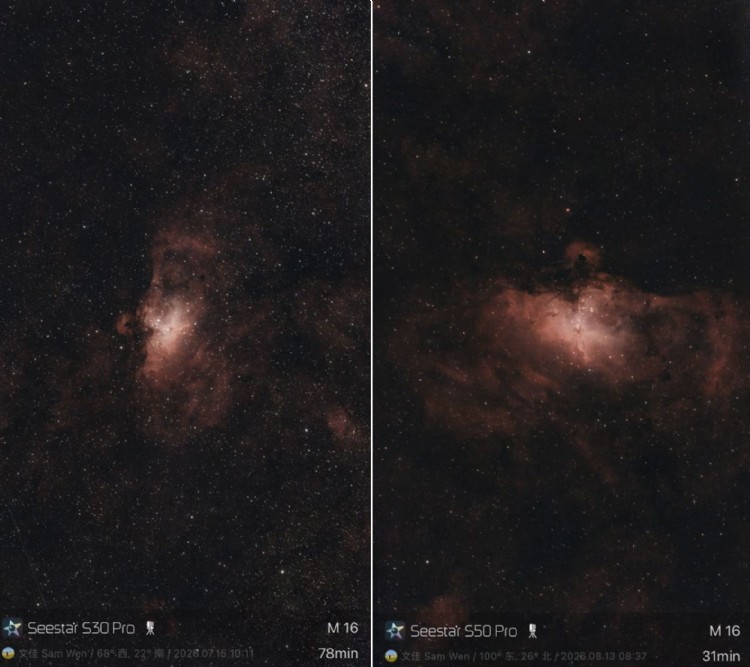
Capturing M16 well requires the ability to resolve fine structure, and this is one area where the S50 Pro has a clear advantage over the S30 Pro. With its 260 mm focal length, the S50 Pro can frame the Eagle Nebula at a larger image scale, revealing the outlines of the three main pillars and the layered structures shaped by stellar winds in greater detail.
The 50 mm aperture provides nearly three times the light-gathering power of a 30 mm aperture, allowing the S50 Pro to record faint nebulosity with stronger signal and reveal more subtle structure and tonal separation.
When imaging M16, I would suggest paying particular attention to the detail visible around the Pillars of Creation in the central region.
Where the S50 Pro fits alongside traditional imaging rigs
ScopeTrader: As the price of a smart telescope rises, it begins to compete with entry-level modular astrophotography systems. Where do you think that crossover occurs, and why should an experienced astrophotographer still choose the integrated S50 Pro?
Sam: From an astrophotography perspective, I think it will become increasingly difficult to draw a clear boundary between smart telescopes and traditional astrophotography equipment. The distinction will continue to blur as smart telescopes become more capable.
As these systems become increasingly intelligent, their imaging success rate may eventually exceed what many users can consistently achieve when manually assembling, configuring, and operating a traditional system. The S50 Pro represents a significant step in this direction, with performance moving closer to that of professional astrophotography systems.
Of course, the range of smart telescopes available today is still relatively limited. Users seeking the absolute highest image quality will often still choose a traditional astrophotography setup. But that does not prevent experienced astrophotographers from also owning a capable smart telescope such as the S50 Pro.
Here's why:
Traditional astrophotography systems typically use larger apertures and require a telescope, equatorial mount, camera, and other accessories to form a complete system. When imaging away from home, assembly, cabling, setup, and calibration can take considerable time.
Seestar, by contrast, is lightweight and highly integrated. Users can begin imaging within minutes of setting it up and powering it on. Many spectacular astronomical events have relatively short observing windows, and in those situations Seestar's ability to deploy quickly becomes particularly valuable.
Travel is another important use case. Astrophotography is highly dependent on observing conditions, and enthusiasts often want to bring equipment with them when traveling. Traditional systems can be large and heavy, making it difficult to carry a complete setup, particularly when traveling with family. Seestar is much easier to take along.
For experienced astrophotographers, therefore, smart telescopes and traditional systems are often complementary rather than mutually exclusive. Many users may find value in owning both.
What comes next for smart telescope technology?
ScopeTrader: Many of today's popular astrophotography sensors have now been in use for five years or more. Larger optics can provide greater light-gathering capability and resolution, but where do you believe the next major leap in smart telescopes will come from: a new generation of sensors, better optics, more advanced processing, or a combination of all three?
Sam: The next truly significant breakthrough in smart telescopes will most likely not come from a single technology, but from advances across multiple areas working together. Of course, one particular technology may make a breakthrough first.
Sensors: A new generation of sensors can address some of the limitations of existing technology while improving performance and image quality. However, achieving a truly transformative leap is not easy, as we can also see from the evolution of smartphone imaging technology.
Optics: More advanced optical designs may allow us to shorten the optical path and reduce the physical size of the system while maintaining the same aperture and focal length, making the overall telescope more compact.
Algorithms and software: There is still considerable room for improvement in post-processing, target locating, automated imaging, and other areas. More advanced algorithms can automate many tasks that currently require manual intervention.
Innovation may also come from mechanical design and other technical areas. So I don't think the future of smart telescopes will be defined solely by sensors, optics, or algorithms. It will more likely come from the evolution of multiple technologies working together to improve the overall user experience.
Will ZWO make a monochrome Seestar?
ScopeTrader: Could you see ZWO producing a monochrome Seestar with an automated filter system? Would the increased sensitivity and narrowband performance justify the additional imaging time and complexity?
Sam: Based on current user demand, there is not yet a strong demand for monochrome sensors among smart-telescope users. However, we continue to pay close attention to feedback and will monitor how these needs evolve as the user base grows.
If, in the future, enough users want to image with a monochrome sensor combined with an automated filter system, we would certainly consider that product concept. At this stage, however, we have no concrete plans to launch such a product.
System complexity is an important boundary for us. Seestar's original mission is to lower the barrier to astrophotography. If adding more professional features makes the system complicated again, we risk moving away from that original goal.
Even if we introduce more advanced features and imaging capabilities in the future, our goal would not be to confront users with more complicated operations. Instead, we want to hide that complexity through thoughtful product design and automation.
The capabilities can become more sophisticated while the user experience becomes simpler.
Inside the redesigned S50 Pro four-element APO optics
ScopeTrader: What is the least obvious compromise or engineering effort your team made while developing the S50 Pro — something users probably would not recognize from reading the specification sheet?
Sam: I would say it is our folded four-element APO optical system. For serious deep-sky astrophotography, users have very high expectations for star quality, and this is an area in which we invested a tremendous amount of engineering effort with the S50 Pro.
To achieve pinpoint stars across the entire frame of the 1/1.2-inch sensor, we completely overhauled the optical design of the original S50. We not only increased the number of optical elements, but also significantly improved the precision of the internal fold mirror. We also developed a dedicated star-quality testing system to ensure that every S50 Pro leaving the factory can deliver optical performance comparable to a professional-grade APO telescope.
These are the kinds of improvements that are difficult to communicate on a specification sheet. Experienced astrophotographers know that star quality is one of the clearest indicators of a telescope's optical performance.
That's why the S50 Pro is far more than simply an S50 with a new sensor.
